
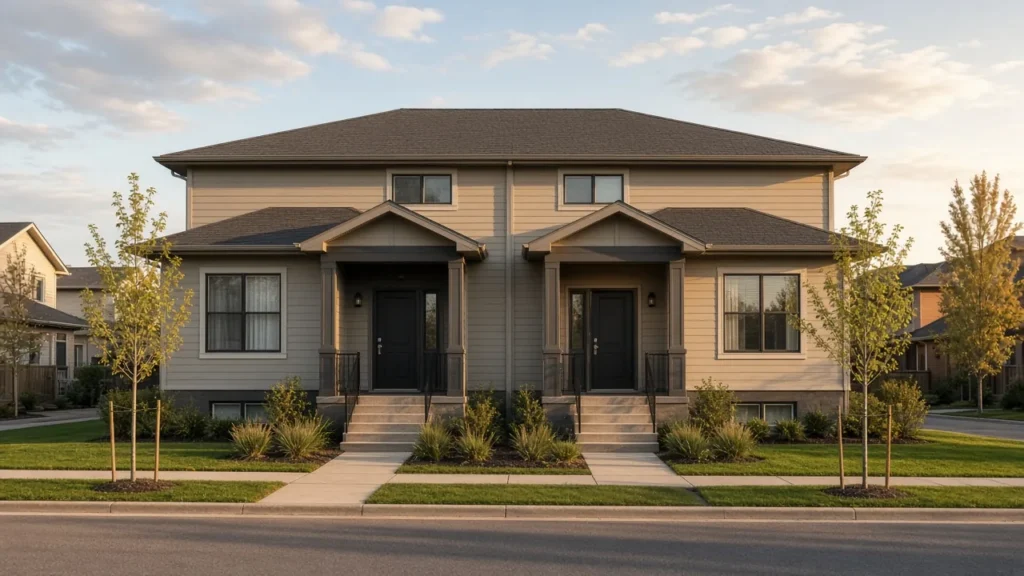
A duplex and a townhome can look alike from the sidewalk. In a Calgary new build, the title decides whether you are buying a lot of your own or a unit in a condominium.
The building shape is not the title
A duplex and a townhome can look similar from the sidewalk. Both are attached homes. In a Calgary new-construction tour, one may be two houses on two lots, and the other may be a unit in a condominium plan. The floor plan will not tell you which. The title will.
Alberta’s land titles guide describes a condominium as separate ownership of a space or a unit, either in a building or on bare land, inside a parcel. Registering a condominium plan cancels the old title for that parcel and creates a separate title for each unit. It also creates a condominium corporation made up of the owners. If the home you like is on a condominium plan, you are buying a unit in that corporation, even when the house has its own front door and a patch of grass.
If there is no condominium plan, you are not buying into that structure. You are buying whatever lot or lots the transfer describes, and there is no condominium contribution created by a plan. Attached walls, easements, and a party wall can still exist. Your lawyer reads those documents. A sales label such as “duplex,” “semi,” or “townhome” does not replace them.
Our page on townhomes without condo fees is the buyer-side overview of the no-fee product. This article is the comparison: when an attached new home is a duplex on its own title, and when it is a condominium townhome.
What Alberta says a condominium can look like
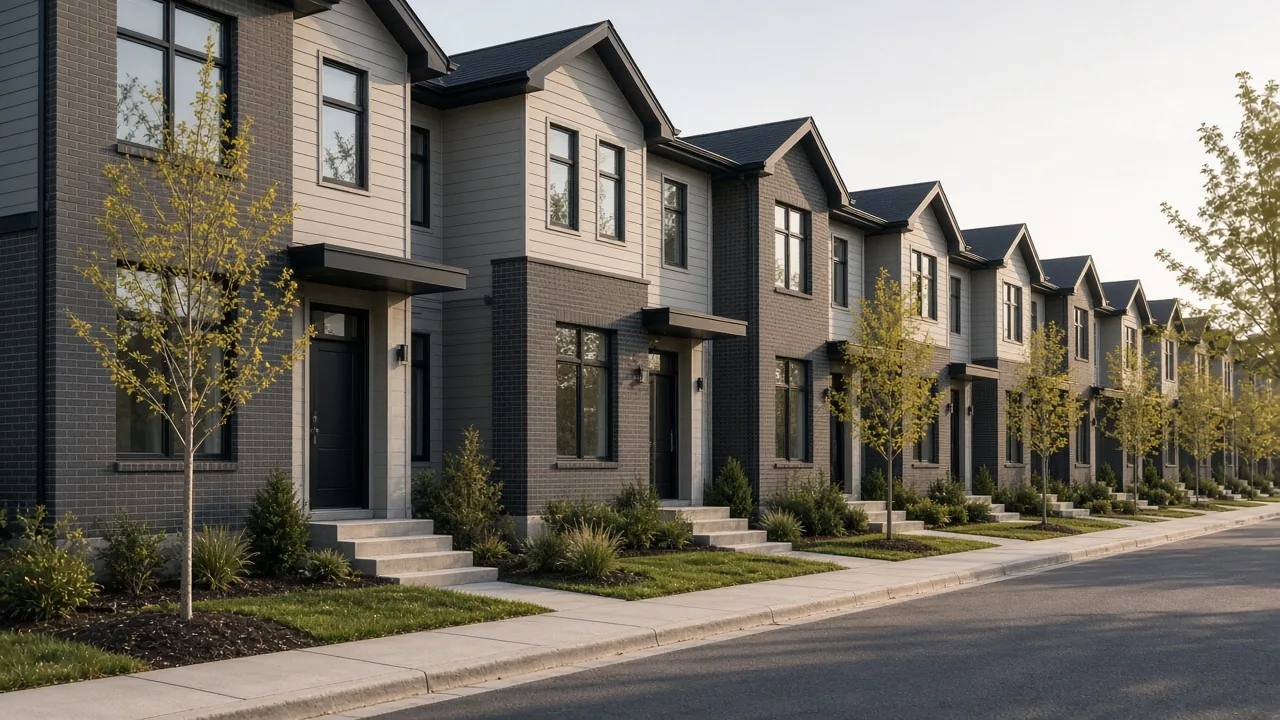
The province’s consumer guide to owning a condominium says a residential condominium is not only an apartment. Complexes can contain detached homes, semi-attached duplexes, or townhouses in a bare land condominium, or a mix of those. So a home that looks like a duplex can still be a condominium unit. A row that looks like townhomes can be bare land units, conventional units, or homes that are not condominiums at all.
In a bare land unit, the same guide says you own the land and what is built on it. Usually the exterior walls, the roof, the foundation, the driveway, and at least part of the landscaping are part of the unit, and the owner maintains them. Those duties can be moved to the condominium corporation if the bylaws say so. That is why two bare land townhomes on the same street can split repairs differently. Read the bylaws for the plan you would join. Do not copy the answer from a different row.
Common property is the part of the parcel on the condominium plan that is not inside a unit. Owners hold it together. There is no separate title for it. Your share is your unit factor. The consumer guide says the factors for all units on a plan add up to 10,000, and the developer has to show how those factors were set. The factor affects your share of contributions and of any special levy. Ask for the factor on the unit in the offer, not the factor on the show home if they are different units.
Duplex on its own title
When buyers say duplex in Calgary, they often mean two homes that share a wall, each with its own entrance. That description is about the building. The ownership question is whether each side has its own certificate of title with no condominium plan.
On that kind of purchase there is no condominium corporation created by the plan, so there is no condominium fee from a corporation. You still insure the home, maintain the roof and the yard on your side, and follow whatever the title says about the shared wall and any easement. A fence, a deck, and the strip beside the sidewalk may or may not be inside your lot. The survey and the contract answer that. A verbal “it’s just like a detached house” does not.
New construction does not change the title test. A brand-new side-by-side can be registered as two lots, or it can be put on a condominium plan before you ever see it. Ask for the plan number, or for a clear statement that no condominium plan will be registered, and have your lawyer confirm it before you remove conditions.
Townhome on a condominium plan
A townhome on a condominium plan is a unit plus a share of the common property. The corporation needs money for insurance on what it insures, snow and grass where the bylaws assign that work, repairs to common property, and the reserve fund. The consumer guide calls the owners’ payments condominium contributions, which buyers usually call condo fees. They are normally tied to unit factors, unless the bylaws set a different formula. The guide also says contributions can go up, and that a special levy can be charged if the corporation needs more than the regular contributions.
None of that appears just because the homes are in a row. It appears because a condominium plan and a corporation exist. A row of fee-simple homes with no plan does not have that corporation. A row that looks identical can have one. The monthly number on a feature sheet is a starting point, not a promise that the number stays flat, and not proof of what the fee covers. Ask for the current budget, what the fee pays, and what the bylaws leave on the owner. The longer cost comparison is in no condo fees versus condo townhomes.
Warranty follows the new home either way
Alberta requires new home warranty when the building permit was applied for on or after February 1, 2014. Minimum coverage on the provincial overview is one year for labour and materials, two years for delivery and distribution systems, five years for the building envelope, and ten years for major structural components. Coverage is attached to the home. It starts on the earliest of occupancy, permission to occupy, or transfer of title.
The new home warranty page says condominium buyers must receive that protection, and that common property can start on a different date than the unit. A duplex that is not a condominium does not have that common-property policy. A townhome that is a condominium does. Ask which file you are in, and confirm the registration in the public registry. Coverage limits on the overview are a minimum of $265,000 for a single-family home and $130,000 for a unit in a condominium or other multi-family building, plus up to $3.3 million for common property of each multi-family building. Those are insurance limits for the structure, not the purchase price.
What to ask before you choose
- Is there a condominium plan, or will one be registered before possession?
- If yes, what is the unit factor, and which bylaws apply?
- Who maintains the roof, the exterior, the driveway, and the yard: you, or the corporation?
- If no plan, what does the title say about the shared wall and the lot lines?
- Is the home you would sign the show home, or a different lot in the row?
- What possession date is in the contract, and is warranty already registered?
ARK represents buyers, not the builder’s sales centre. If you are comparing a side-by-side with a townhome row, bring the plan and the feature sheet and we will line them up with the title questions before you go back.
Is a duplex the same as a townhome?
Not as a legal category. Both words describe attached homes. A duplex is often two homes sharing a wall. A townhome is often one home in a longer row. Either one can be on a condominium plan or on its own title. The plan decides the fees and the corporation.
Can a duplex have condo fees?
Yes, if it is a unit in a condominium, including a bare land condominium. Alberta’s consumer guide lists semi-attached duplexes as one of the housing types that can sit inside a bare land complex. No plan means no condominium contribution from a corporation.
Who fixes the roof on a bare land townhome?
Usually the unit owner, because the guide says the roof, exterior walls, foundation, and driveway are typically part of the bare land unit. Bylaws can move that work to the corporation. Read the bylaws for your plan.
Does new-home warranty change if the home is attached?
The permit-date rule is the same. Condominium units must have the required warranty, and common property can have its own start date. Confirm the registration for the home you are buying.
Compare the title, not the brochure
ARK represents buyers. Bring the plan name and we will sort a side-by-side from a condominium townhome before you sign.
Start a conversation Call 587-800-1605
See townhomes without condo fees and no condo fees versus condo townhomes.